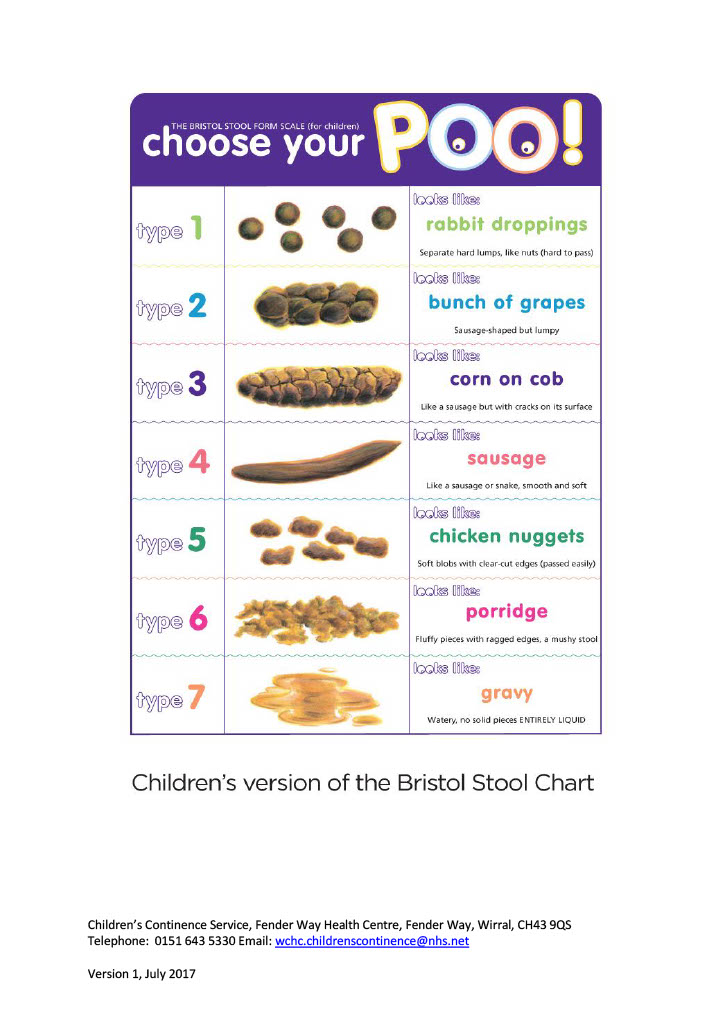

Hard stools or constipation can be a common issue in children and lead to abdominal pain, discomfort with urination, and vomiting in more severe cases. It can also cause looser stools at times as stool leaks around hard stool stuck in the rectum. We commonly use the Bristol scale (see below) to judge constipation. Types 1 & 2 are considered constipation/hard stools and may be helped by suggestions in the “do” section.

How often a child poops is not related to constipation.  Infrequent pooping – if the poops are between play-doh or peanut butter consistency or softer is fine and can be very normal.  This is especially true for breast fed babies older than 4 weeks, but who are not yet eating solids.

Children with “type 1” poop may have one or more bowel movements per day.  They are still constipated.  The best question to determine if a child is constipated is to ask:  “Does it hurt you when you poop?”

How To Help Your Child

Do

  • Give your child foods rich in fiber. Examples:  broccoli, oatmeal and other whole grains, chia seeds, flaxseed, peas, beans, nut butters, sweet potatoes, green leafy veggies, berries, and pitted and dried fruits. Prune juice can also be helpful.

  • Give them lots of water.

  • Consider daily use of a stool softener – a fiber supplement (Citrucel, metamucil, etc) or polyethylene glycol (generic of Miralax).  These are fine to use in children 6 years and up or with our guidance. These stool softeners do not require a prescription.

Don’t

  • Don’t give your child sweetened fruit juices or other sugary beverages (prune juice is the exception)
  • Don’t give your child more than 16 ounces of milk or dairy products. Dairy and other high fat foods tend to worsen constipation.

  • Don’t give your child highly processed foods.
When to Worry

Contact us by texting or calling 503 400 3852 option 2 if child:

  • Potty Training: Hard, dry poop can be painful, and this can slow or make potty training impossible. If a child is afraid to poop, this can cause a lot of resistance to pooping and lead to urine or even stool accidents.

  • Prolonged constipation (many months)  can impact growth and can cause some kids to limit food intake.  When you are constipated, eating food can cause general abdominal pain.

  • Obstipation: If there is soiling (liquid stool) in the underwear and the child denies awareness of having needed to use the bathroom, this is a condition we call “obstipation.” This is very severe constipation, and not unusual in kids with sensory issues, severe anxiety, history of trauma, or who have a very narrow range of foods they will eat. Kids who have stool accidents should be seen in the office.

  • Bright Red Blood: Constipation can cause hemorrhoids or tears of the skin of the rectum or anus. If there is bright red blood after wiping, the constipation should be evaluated and treated. Constipation (especially if it alternates with lots of gas and loose stool) can also be a sign of gluten or other food intolerance.

This advice about symptom relief is intended to equip you to help your child at home. If you have continued concerns please contact our office. If this is a medical emergency, please call 911 and us. We can also help during an emergency.

If you are not a Small Town Pediatrics family, please contact your child’s medical office or click Accepting New Patients to register your child with us.